Stockopedia | Share Prices, Share News and Company Research

Don't miss out on our free "How to Make the Most of Stockopedia" Webinar this Wednesday May 29th - sign up details here

Summer Reading: 12 of the Smartest Books on Stock-Picking Ever Written (part 1)

Monday, Jul 02 2012 by
7
Summer Reading 12 of the Smartest Books on StockPicking Ever Written part 1

As we've been developing the screening & analysis tools for Stockopedia PRO over the last 18 months, we've been doing a VAST amount of reading and careful re-reading of all kinds of investment books - from the old classics to the latest books, research papers & articles hot off the press... With the summer holidays approaching, we've been reflecting on the very best of those books, the true classics that stand out above the rest. The test we've been applying for this is: we're looking for investment books that are accessible and actionable. They must have a very high density of ideas but not just be abstract academic tomes - can you also "smell the money"?

After much debate at Stockopedia Central, here is a list, in two parts, of the 12 books that we think are so jam-packed full of interesting, important or damn-right cool investment ideas that anyone who calls them a serious investing ninja really ought to be familiar with them. If you've got some time away from the kids to read and chill by the pool this summer, you could do a lot worse than devour some of these books from cover to cover....

Got your thumbs and Kindles ready? Ok, let's go.
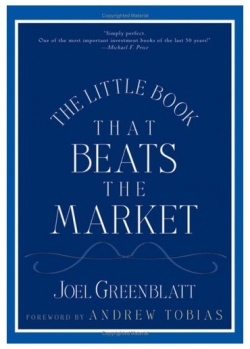
1. The Little Book That Beats the Market (Joel Greenblatt - 176 pages)A New York Times bestseller, this is Joel Greenblatt's attempt to write an investing book that everyone, including his children, could read and learn from. A widely respected hedge-fund manager, Joel Greenblatt started as a value purist but was influenced by Warren Buffett's views about growth being part of the value equation. He founded Gotham Capital, a fund which returned over 40% annualized from 1985 to 2005. In the "Little Book",  Greenblatt espouses as a do-it-yourself version of his investing approach, which he calls the Magic Formula.

You might be put off by that phrase and frankly the book title but, whether you buy into the idea of Formula investing or not, this book is well worth the (very) limited time it takes to work through. It's a testament to clear thinking and will make you re-evaluate your own investment process. At just £9.30 on the Kindle, it's also a snip and frankly belongs on every investor's bookshelf. 

2. Value Investing: Tools & Techniques for Intelligent Investors (James Montier - 414 pages)James Montier now works for GMO but was the former head of Global Strategy at SocGen. While there, he put out a series of fascinating research papers which combine fascinating academic evidence, worldly practitioner wisdom and an entertaining writing style. This book essentially collates them, while filling in some conceptual gaps.

 It's perhaps not as practical a book as some of the others we'll mention (although it is in parts, particularly on the short-selling side) but it covers some incredibly important ground. Montier hammers away very effectively at a lot of received wisdom in finance, including the ′efficient market hypothesis′ and the industry's obsession with (in his view, utterly flawed) DCF analysis. 

It's not cheap and if you're so inclined (plus a bit tight!), you can find many of Montier's various papers online but having them assembled like this makes them accessible (especially by the pool!). Sometimes, the origins of this book as a collection of articles shows through, but the wealth of ideas covered more than makes up for any deficiency in narrative structure. 

3. Your Next Great Stock (Jack Hough - 250 pages): As you can probably guess, we love stock-screening and this is a fantastic book written on the topic back in 2007. Jack Hough writes the Stock Screen column for SmartMoney Magazine. Much like our team of late, he spends his working hours poring through academic studies on stock market anomalies, trying to figure out what could be applied in practice, and thinking about the discipline of picking stocks. This book is his attempt to convey that wealth of knowledge in a practical way that's not overwhelming for the novice investor.

 Special Offer: Invest like Buffett, Slater and Greenblatt. Click here for details »

Divided into four parts, it's the first half that is particularly good - in it, he discusses the key elements of stock screening and looks in detail at a dozen or so powerful stock–screening strategies that Hough concede he has "shamelessly stolen" from the world′s greatest financial minds (e.g. his "Combination Platter" screen is basically Piotroski). If you're looking to get started with stock screening, this is the book to read.

4. What Works on Wall Street (James O'Shaugnessy- 720 pages): This classic guide to investing is an excellent resource for any serious investor interested in evidence-based investing. It uses historical data rather than anecdotal evidence to analyse which specific strategies pay off over time. O'Shaughnessy was director of systematic equity at Bear Stearns, where he was in charge of all quantitative investing. As a result, he's spent a lot of time back-testing the performance of dozens of stock-picking strategies (from high dividend yields, low P/B to a range of growth strategies) over long time periods. As he points out, most investors are mediocre and would be better off indexing to the S&P 500. Instead, he advocates a more scientific method to stock market decision-making and portfolio construction. This book is not for the faint hearted –it's very long with lots of statistical tables & charts. However, it's worth the effort.

The one weakness of this book is the strong US bias - there's no discussion of how these strategies might operate in other markets outside the peculiar bubble of the US stock market. However, we're modelling a couple of the strategies discussed in "What Works on Wall Street" for UK stocks (Cornerstone Growth and Cornerstone Value) as part of Stockopedia PRO.  

5. Contrarian Investment Strategies (David Dreman - 400 pages): First published in 1998, this is a best-selling book on value investing by Dreman, a regular columnist for Forbes magazine and the founder/CEO of Dreman Value Management. It sets out Dreman's contrarian investment philosophy, which he attributes to losing 75% of his net worth simply by following popular stocks in the late 1960s. A subsequent interest in analysing the psychology of the market and the emotions that can distort the valuations of fashionable stocks helped him to develop a contrarian approach that seeks to take advantage of the misjudgements of other investors. We're modelling a number of Dreman's approaches in the Screening Centre. Annoyingly, this book doesn't seem to be available on the Kindle. There is  a more recent edition which is available, although that appears to have been completely re-written and is much more focused on behavioural psychology.

6. The New Buffettology (Mary Buffett - 288 pages) - In the absence of a definitive masterpiece by the great man himself, this book is perhaps the next best thing. Mary Buffett was married to one of Warren Buffett's sons in the 1980s. At Christmas, Warren Buffett apparently used to play the "jolly billionaire version of St. Nicholas," tossing around envelopes filled with $10,000. He later switched to doling out $10,000 in stocks (Mary Buffett calls it "the gift that kept on giving") instead of cash after deciding family members needed to take a stronger interest in the family business. This apparently led to her curiosity about his investment ideas and, along with David Clark, she sought to provide a methodical summary of his approach.  The original book, "Buffettology: The Previously Unexplained Techniques That Have Made Warren Buffett the World's Most Famous Investor", was published in 1997  - a more recent edition, "The New Buffetology" was released in 2002.

Overall, it's an an excellent, easy to read guide which is packed full of interesting ideas & analysis of Buffett's quality-based approach to investing (see this summary). It provides a useful conceptual framework for reading his Berkshire Hathaway Shareholder Letters, which we would also highly recommend. 

That's it for now. We'll be covering the remaining six books in a subsequent article here. And don't forget to sign up for your free copy of our latest book on value investing and our forthcoming dividend book.


Filed Under: Investing, Investing Books,
There's value in the stock market
but do you know where to look?

Get the most concise synopsis of everything that's been proven to work in value investing. If you like your stocks cheap you've found a treasure trove distilled to under 70 pages.

  • How to find ultimate Bargain Stocks with Ben Graham
  • How to spot Turnarounds and avoid Value Traps
  • From Graham to Greenblatt via Piotroski & Lakonishok
  • How to value stocks and set a margin of safety

Soon to be retailing for an RRP of £14.99, for a limited time only,
you can get your copy free by joining our 35,000 strong mailing list.

*By signing up you'll be joining our mailing list
no junk, no spam - just great content like this example.


Disclaimer:  

As per our Terms of Use, Stockopedia is a financial news & data site, discussion forum and content aggregator. Our site should be used for educational & informational purposes only. We do not provide investment advice, recommendations or views as to whether an investment or strategy is suited to the investment needs of a specific individual. You should make your own decisions and seek independent professional advice before doing so. Remember: Shares can go down as well as up. Past performance is not a guide to future performance & investors may not get back the amount invested.


Do you like this Post?
Yes
No
7 thumbs up
0 thumbs down
Share this post with friends


1 Comment on this Article show/hide all

UK Value Investor 4th Jul '12 1 of 1
2

Thanks for the list guys. personally I like Buffettology best, because it's so practical and formed the first foundation stone of how I pick stocks now.

To your list (which isn't finished... I know I know) I would add BG's Intelligent Investor of course. It's like a nuclear sledgehammer of common sense. Graham is the main man, mostly because he unfailingly critiques his own ideas if they haven't worked, and constantly emphasises the uncertainty of it all.

Looking forward to part 2.

Newsletter: UK Value Investor
| Link | Share

What's your view on this article? to Comment Now


You are feeling neutral

Use the £ sign in front of a ticker to turn £VOD into Vodafone PLC

You can track all @StockoChat comments via Twitter


About Stockopedia Features

Stockopedia Features covers in-depth stories on strategies, companies and themes that are relevant to online investors. Investing is hard work. We don't try to over-simplify complex concepts - we prefer to try to help you navigate the detail.  more »


Stock Picking Tutorial Centre


Related Content

Stock Picking Simplified

Stockopedia takes your stock picking to the next level with cutting edge Stock Reports & Screening tools.