Stockopedia | Share Prices, Share News and Company Research

The 5 Key Signs of an Economic Moat

Tuesday, Jan 24 2012 by
12
The 5 Key Signs of an Economic Moat

In spite of a dozen years of sideways markets that have just about ground the philosophy of buy and hold into the dust, Warren Buffett's purchase decisions are still able to turn a thousand heads. Investors know that what really interests Buffett are companies with 'durable competitive advantages' which promise enduring high returns on capital and free cashflow in his pocket.

By upping his stake in Tesco (LON:TSCO) last week Buffett was signalling his confidence in the longevity of its advantage especially as the argument for Tesco's investment case on valuation grounds alone is perhaps only moderate.

So how can we as investors learn to spot companies with durable competitive advantages?


What is a durable competitive advantage?

Buffett likened businesses to castles at risk of siege from competitors and the marketplace. Great companies are able to dig deep economic moats around their castles that become increasingly impregnable to competition and market pressures. These moats bring either pricing power or cost reductions which help sustain very high returns on capital, leading to higher cashflows and returns for investors. Clearly everyone would like to own a business with a wide economic moat but Buffett has been most systematic in tracking them down.

How to think about Economic Moats
The Little Book That Builds Wealth: The Knock-out Formula for Finding Great Investments (Little Books. Big Profits): Amazon.co.uk: Pat Dorsey: Books

One of the best books on the subject is very small and easily digestable - "The Little Book that Builds Wealth" by Pat Dorsey of Morningstar - and comes extremely highly recommended. Morningstar have developed the concept of an economic moat into a structured framework. Essentially 'wide' moat businesses have one of 2 attributes - high pricing power or low cost advantages - which in turn lead to sustainably high margins and returns on capital investe. These advantages can be split into the following categories…

1. Intangible Assets

Intangibles are basically things you can't see - i.e. Brands, Patents and Regulatory approvals rather than tangible assets like factories or distribution systems. Intangible assets can be unique to companies and deliver fantastic pricing power.

  • Brands - While Brands are a dime a dozen these days, not all give the owner the ability to price at a premium. While Coca Cola may be able to charge a fortune for sugared water, French Connection can't charge a premium for its bargain bucket fashions. Be careful and pick only premium brands.
  • Patents - think Viagra while it lasted [sic]. Effective Patents of great products are a licence to print money as they provide monopoly conditions. But patent lawyers are not poor, and litigation can be rife… so be careful. Patents also expire, so watch out for single patent companies.
  • Regulatory Approvals - excellent returns can be found in such eclectica as waste disposal sites, credit rating agencies or financial services firms. Look for big barriers to entry due to high regulatory hurdles which can lead to pricing power.

2. Switching Costs

Banks historically have been able to charge nosebleed fees to their customers because people just can't be bothered with the hassle of switching banks. Similarly costs of switching are high for companies or individuals that rely on integrated software - data processing, tax or accounting can be great businesses (e.g. Sage (LON:SGE) , Intuit).

3. Network Effects

This is a form of switching effect that is so powerful it deserves its own category. Think about Ebay and the fact that no other auction site can compete, or Facebook in the social graph. But its not just internet companies. Credit Card companies like Visa or Amex with millions of pay points benefit from massive network effects as does Microsoft with a virtual monopoly in office software due to the fact that everyone needs to open .doc and .xls files. But watch out - network effects can break down - witness falling margins in stock exchanges as new competition enters.

 Special Offer: Invest like Buffett, Slater and Greenblatt. Click here for details »

4. Cost Advantages

When considering investing in an industry always consider whether there are easily available substitutes as a company's cost advantage can be small or temporary - witness the poor economics in Airlines, Autos or microchips. But cost advantages can be sustained for a long time in certain situations - Dorsey discusses four sources - cheap process, better location, unique assets and scale benefits…

  •  Cheaper Processes  - While some companies (think Dell or Southwest Airlines) have been able to carve out unseemly profits due to a better process, Dorsey cautions that they are not as enduring as other moats. A company like ASOS (LON:ASC) may be winning with web savvy marketing at present, but it may not last!
  • Location, Location, Location - Think quarries, waste haulage and local steel mills. Heavy, cheap products are best in local networks as competitors can't ship in products to compete economically - gravel can be a better business than liquid natural gas due to the low value to weight ratio.
  • Unique Assets - If you can own commodity assets with lower extraction costs than any other competitor then obviously you'll have a great moat.

5. Greater Scale

Dorsey describes scale as the king of cost advantages and breaks it further down into distribution, manufacturing and niche markets.

  • Distribution Networks - Industries with higher fixed costs relative to variable costs tend to be more consolidated - think Fedex vs Estate Agents. Any guy with a phone can be an estate agent but you can't easily compete with a national parcel distribution network! Half full vans cover fixed costs so additional parcels go straight to bottom line, difficult to compete with.
  • Manufacturing Scale - Massive upstream oil refining scale at Exxon Mobil is an example. But its also evident in massive sales distribution networks - for example in marketing video games. Electronic Arts can spread the cost of developing a game over a massive sales network. British Sky Broadcasting (LON:BSY) in the UK can dominate its rivals with massive subscriber network and the satellite dish switching cost.
  • Niche Markets - Small niche markets, like local cable networks, or school software can also be incredibly profitable niches.

How can you screen for economic moats?

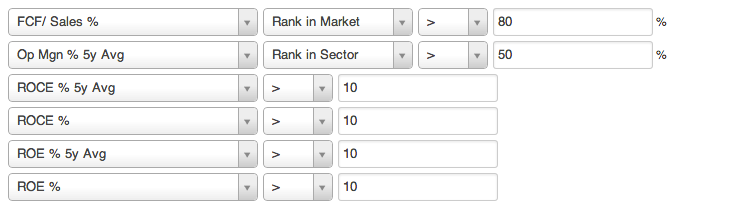
We've been thinking hard about how to screen for economics moats as part of Stockopedia Pro. The most obvious financial sign of an economic moat is the ability to generate a higher rate of free cash flow. This is the cash generated by the business after all capital expenditures (factory improvements etc) have been paid off. Effectively, this is cash in the pocket of the firm which can either be reinvested or paid out in dividends. Valuation 101 shows that a company is only worth the present value of its future cashflow so the higher the rate of cashflow generation, the higher the value of the company. If free cashflow to sales is 5% or greater you may have found a company that can print money.

Warren Buffett also looks to companies that can generate high sustainable returns on capital and returns on equity compared with their peer group. Returns of 12% and higher on a long term basis may indicate a company with pricing power or cost advantages. The Dupont Formula shows that higher ROE can be due either high profit margins, high asset turnover or from high leverage - make sure a high ROE isn't just coming from high leverage!

Caution 1: False Moats

There are a few busines attributes that you should be aware of that are potentially false moats… beware of companies that promote their great management, great execution, great products and big market share. These attributes do not bring a sustainable advantage on their own. The history of business is littered with the wrecks of companies with false moats - RBS (Fred the Shred), Palm Pilots (Product), Kodak/Blackberry (Market Share) to name a few.

Caution 2: Steer clear of industries with bad economics

Investing is a game of odds, and investors should take another leaf out of Buffett's book by playing the game of the 'Snowball'. If you invest in an industry with good economics you are far more likely to end up a winner as the odds are more stacked in your favour.

Dorsey highlights that far wider economic moats are found in industries like Media, Healthcare, Business Services, Asset Management, Consumer Goods and Software than in industries with occasionally brutally awful economics like Hardware, Industrial Materials and Retail (switching costs too low!).

Bet rarely, bet heavily...

The stock market allows you to play any strategy you like from trying to pick growth stars to going after turnaround 'cigar butt' stocks. But many of these strategies only shine temporarily and year to year market stars have a tendency to burn out. Transaction costs will kill your returns. Buffett has shown that choosing only to invest in easily understood companies with durable moats at favourable prices is the best route to investment success, as the miracle of compounding does the rest of the hard work for you.

The trouble is these companies can be very rare and hard to find. Which companies do you know in the UK market that have the above attributes? And at what price are they bargains? Let me know in the comments below.

There's value in the stock market
but do you know where to look?

Get the most concise synopsis of everything that's been proven to work in value investing. If you like your stocks cheap you've found a treasure trove distilled to under 70 pages.

  • How to find ultimate Bargain Stocks with Ben Graham
  • How to spot Turnarounds and avoid Value Traps
  • From Graham to Greenblatt via Piotroski & Lakonishok
  • How to value stocks and set a margin of safety

Soon to be retailing for an RRP of £14.99, for a limited time only,
you can get your copy free by joining our 35,000 strong mailing list.

*By signing up you'll be joining our mailing list
no junk, no spam - just great content like this example.


Disclaimer:  

As per our Terms of Use, Stockopedia is a financial news & data site, discussion forum and content aggregator. Our site should be used for educational & informational purposes only. We do not provide investment advice, recommendations or views as to whether an investment or strategy is suited to the investment needs of a specific individual. You should make your own decisions and seek independent professional advice before doing so. Remember: Shares can go down as well as up. Past performance is not a guide to future performance & investors may not get back the amount invested.


Do you like this Post?
Yes
No
19 thumbs up
7 thumbs down
Share this post with friends


Tesco PLC is an international retailer. The activity of the Company is retailing and associated activities in the United Kingdom, the People’s Republic of China, the Czech Republic, Hungary, the Republic of Ireland, India, Malaysia, Poland, Slovakia, South Korea, Thailand, Turkey and the United States. The Company also provides retail banking and insurance services through its subsidiary, Tesco Bank. The services it offers in store, such as optician, pharmacy, phone shop or customer restaurant. As of February 25, 2012, it had over 180 opticians. Click & Collect is a component of its multi-channel offering. Its store and distribution networks give customers the opportunity to pick products whenever it suits them from over 770 stores, close to where they live or work. As of February 25, 2012, it had 45 stores, which offers grocery Click & Collect. In September 2012, it acquired Mobcast. In March 2013, the Company acquired Restaurant Group Giraffe. more »

Share Price (Full)
380.8p
Change
6.9  1.8%
P/E (fwd)
11.5
Yield (fwd)
4.0
Mkt Cap (£m)
30,681

Asos Plc is that of a holding company. The principal activity of its subsidiary undertakings is that of Internet retailing. ASOS.com is a global online fashion and beauty retailer, offering over 50,000 own label and branded product lines across womenswear and menswear, to customers in over 190 countries from its central distribution centre in the United Kingdom. Through its Global Free Shipping offering, ASOS delivers these products to customers for free in over 190 countries from its central distribution centre in the United Kingdom (Barnsley). Alongside global free shipping, customers can also choose a variety of other paid delivery methods and speeds in each territory. It sources brands from worldwide and has over 1,000 brands in its, portfolio including American Apparel, Denim & Supply and Polo by Ralph Lauren, Jack & Jones, Cheap Monday and Zadig and Voltaire. As of March 31, 2012, it had 7.95 million Registered Users and 4.38 million active customers from 160 countries. more »

Share Price (AIM)
3826p
Change
87.0  2.3%
P/E (fwd)
60.3
Yield (fwd)
n/a
Mkt Cap (£m)
3,119

The Sage Group plc, along with its subsidiaries, is principally engaged in development, distribution and support of business management software, and related products and services for medium-sized and smaller businesses. It operates in four segments. Its products and services range from accounts, enterprise resource planning (ERP) and payroll software to payment processing, customer relationship management (CRM) and industry-specific solutions, such as healthcare, manufacturing, non-profit and construction. In March 2013, The Sage Group PLC announced that it has completed the sale of Sage ACT! and Sage Saleslogix to Swiftpage and Sage Nonprofit Solutions to Accel-KKR. In May 2013, The Sage Group PLC completed the sale of C&I, ATL, Automotive and Aytos. more »

Share Price (Full)
363.5p
Change
7.2  2.0%
P/E (fwd)
15.8
Yield (fwd)
3.2
Mkt Cap (£m)
4,240


  Is Tesco fundamentally strong or weak? Find out More »


7 Comments on this Article show/hide all

Edward Croft Stockopedia Staff Member 24th Jan '12 1 of 7
4

If Retail is so blindingly competitive and Tesco is perhaps only fairly valued - what is the economic moat that Buffett sees in Tesco? While growth has appeared to stall and international expansion hasn’t worked as planned Tesco has dominated the UK for 20 years with scale and cost advantages backed up by great management and execution. This dominance has been shown in Tesco’s historically top tier margins and returns on equity which now appear to be being eaten away by the competition but which Buffett clearly considers only temporary.

Did Buffett spot an opportunity to buy a wide moat company with a golden future at an opportune moment, or is he just settling for a reasonable rate of return on £500m relative to the size of his assets?

“Berkshire’s past record can’t be duplicated or even approached. Our base of assets and earnings is now far too large for us to make outsized gains in the future.” Warren Buffet as quoted on CNN, 2008


Blog: Follow @edcroft on Twitter
| Link | Share | 2 replies
Budlab 24th Jan '12 2 of 7
1

Geart Article! Readers might also like ... MOATS : The Competitive Advantages of Buffett and Munger Businesses discusses the "competitive advantages" of 70 selected businesses purchased by Warren Buffett and Charlie Munger for Berkshire Hathaway Incorporated. This is a useful resource for investors, managers, students of business around the world. It also looks at the sustainability of these competitive advantages in each of the 70 chapters. The MOATS book introduction audio mp3 file: http://www.frips.com/moats.mp3

Here is some basic information that you can pass around the web. Moats : The Competitive Advantages of 70 Buffett and Munger Businesses is now available on Lulu.com in both hardcover and paperback here: http://www.lulu.com/spotlight/4filters It will be on Amazon.com in mid to late February.

| Link | Share
emptyend 25th Jan '12 3 of 7
3

In reply to Edward Croft, post #1

what is the economic moat that Buffett sees in Tesco?

THAT is a very good question indeed - though (since he also owns Walmart stock) perhaps it is simply a question of scale?   ..........which makes your other points also relevant:

While growth has appeared to stall and international expansion hasn’t worked as planned Tesco has dominated the UK for 20 years with scale and cost advantages backed up by great management and execution. This dominance has been shown in Tesco’s historically top tier margins and returns on equity which now appear to be being eaten away by the competition but which Buffett clearly considers only temporary.

The central question is whether the recent news from Tesco is a minor stumble or the start of a walk into the wilderness of strategic confusion. When big companies lose it, they can lose it big....witness the banks and the likes of Kodak (whose moat was breached by digital technology in which Kodak never tried hard enough to lead).

ee

| Link | Share
UK Value Investor 26th Jan '12 4 of 7

In reply to Edward Croft, post #1

Personally I don't see that Tesco has a great economic moat in comparison to its competitors. To me the brand name means zip. I will buy at whatever supermarket is closest to me or delivers to me. There are some elements of scale but I don't think they make Tesco a different KIND of supermarket to Sainsbury, just a slightly bigger one.

When I was a kid Tesco sucked. They were the cheapo supermarket and Sainsbury's were king. I don't think it's impossible for the next 10 or 20 years to see that situation reversed.

But that's an issue for Buffett. For most investors, even if you're buy and hold, I think Tesco is very likely to be good to you at these prices. They're almost certain to grow at or above inflation and the yield is about 5%? So inflation plus 5% sounds okay to me.

For us shorter term investors there's always the opportunity that the investment environment won't always be this glum and we'll get a healthy dose of capital appreciation as Mr Market cheers up. In the meantime, owners can sit back and get that growing dividend and know that Tesco is a very relatively safe share.

Newsletter: UK Value Investor
| Link | Share | 1 reply
monal1 24th May '12 5 of 7

In reply to UK Value Investor, post #4

Tesco are great at grabbing market share from non food retailers.If they are aggresive enough we may see the likes of Argos wiped off from the high street.Thier moat is thier presence in every format everywhere and ready to strike.

| Link | Share
gfourmoney 4th Feb 6 of 7

I think a large part of Tesco's moat is "Clubcard". It is a massive database of customers all providing market research to Tesco at very low cost to the company. The opportunities for cross selling are enormous. With Tesco having moved heavily into non food and finance the database is a pre existing customer set waiting to buy. Tesco own Clubcard so all of the opportunities are there's alone. Other supermarkets have gone the way of outsourcing rewards. I think that may prove to be a mistake.

| Link | Share
toddwenning 10th Feb 7 of 7
3

Hi Ed,

In Dorsey's book, The Five Rules for Successful Stock Investing, he provides the following metrics for moat evaluation

FCF/Sales > 5%
Net margin >15%
ROE > 15%
ROA > 6-7%

These figures also need to be evaluated over time, however, as one year of strong results is not necessarily indicative of an economic moat. In addition, some qualitative assessment is necessary before confirming a moat, but Dorsey's metrics are a good starting point for a screen.

As for Tesco's moat, despite some slip ups in execution and a misguided adventure in the US with Fresh & Easy, it still has a fair amount of bargaining power with suppliers and is thus able to offer low prices and generate a decent profit. As a shareholder myself, I'm disappointed that the company expanded so aggressively concurrent with the rise in online shopping and entered into a pricing war with domestic competition, but retail is a tough business. Longer-term, I think the company will retain some advantages, but perhaps not as much as in the past. Further, as gfourmoney mentioned, the Clubcard database is a valuable intangible asset.

Best,

Todd

| Link | Share

What's your view on this article? to Comment Now


You are feeling neutral

Use the £ sign in front of a ticker to turn £VOD into Vodafone PLC

You can track all @StockoChat comments via Twitter

 Are Tesco's fundamentals sound as an investment? Find out More »


About Edward Croft

Edward Croft

Follow

CEO at Stockopedia where I weave code, prose and investing strategies to help investors beat increasingly corrupt stock markets. I've a background in the City and asset management but now am more interested in programming finance tools for the web.  Traditionally investors online have had very poor access to the best statistics, analytics and strategies for the stock market and our aim is to set that straight. Why can't there be total transparency not only of who has been buying stocks but why? High Quality fundamental information has been prohibitively expensive in the past and often annoyingly dull. People these days don't just want to know the PE Ratio and look at a balance sheet. They expect a layer of interpretation over data. And ideally they want data to be visualised. That's our sole goal... to bring these tools to individual investors around the globe. The other big bugbear of mine is the quality of information that often spreads by word of mouth. People get shepherded in to low quality stocks time and time again due to nothing but a catchy story like "China is huge, this company makes China widgets". Without true fundamental backing for a stock stories are just that... thin air... and as Warren Buffett says - "Its only when the tide goes out that you find out whose been swimming naked". more »


Stock Picking Tutorial Centre


Stock Picking Simplified

Stockopedia takes your stock picking to the next level with cutting edge Stock Reports & Screening tools.